



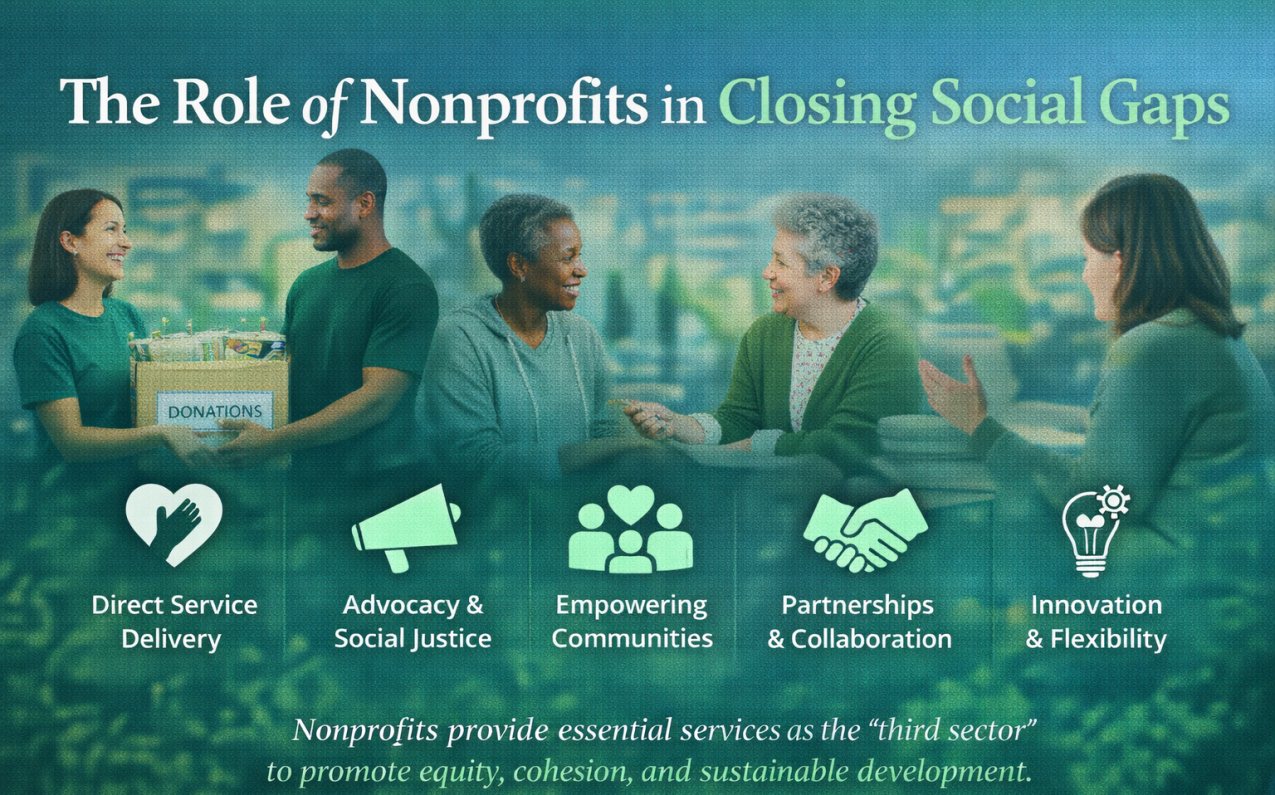
In communities around the world, significant gaps exist between those who have access to essential resources and those who do not. These gaps can appear in many forms – limited access to healthcare, unequal educational opportunities, food insecurity, housing instability, and social exclusion. While governments and private-sector organizations attempt to address these challenges, many communities still find themselves underserved. This is where nonprofit organizations step in.
Nonprofits serve as a critical force for social change. They exist to identify unmet needs, respond to urgent challenges, and advocate for sustainable solutions that uplift individuals and communities. Acting as a bridge between institutions and the people they serve, nonprofits operate within what is often called the “third sector” – a space dedicated to public service, compassion, and community-driven solutions.
In an era where social inequality continues to widen in many regions, the role of nonprofits in closing social gaps has become more important than ever. From supporting youth aging out of foster care to assisting older adults facing social isolation, nonprofit organizations are helping to build stronger, more inclusive communities.
Understanding Social Gaps in Modern Society
Social gaps refer to disparities in access to opportunities, resources, and essential services among different groups within society. These disparities can be caused by a wide range of factors, including economic inequality, systemic barriers, geographic location, discrimination, and lack of public infrastructure.
For example, some communities may lack adequate healthcare services, while others struggle with housing affordability or access to quality education. Vulnerable populations – including low-income families, seniors, individuals with disabilities, and young adults transitioning out of foster care – often experience these gaps more intensely.
When these disparities remain unaddressed, they can create long-term cycles of poverty, social exclusion, and diminished well-being. This is why the presence of organizations dedicated to addressing these gaps is so essential.
Nonprofits often become the first line of support for individuals navigating difficult life circumstances. They respond to needs that may fall outside the reach of traditional institutions, offering programs that promote stability, empowerment, and dignity.
Nonprofits as the “Third Sector” of Society
Nonprofit organizations are commonly referred to as the third sector because they operate alongside government institutions (the public sector) and private businesses (the market sector). Unlike businesses that prioritize profit, nonprofits are mission-driven and focus on advancing social good.
Their primary goal is to improve lives, strengthen communities, and advocate for a more equitable society.
Because of their community-centered approach, nonprofits often have a deeper understanding of the challenges people face. They are able to work closely with local populations, listen to their concerns, and develop programs tailored to meet real needs.
This flexibility allows nonprofits to act quickly and creatively in response to emerging social issues. Whether addressing homelessness, providing mental health support, or helping marginalized groups access opportunities, nonprofits fill essential roles that might otherwise remain neglected.
Direct Service Delivery: Meeting Immediate Needs
One of the most visible and impactful roles of nonprofit organizations is direct service delivery. Across the world, nonprofits provide essential services that support individuals and families during difficult times.
These services often include:
- Access to healthcare and mental health support
- Housing assistance and transitional housing programs
- Educational support and mentorship programs
- Food distribution and nutrition services
- Employment readiness and financial literacy training
For example, nonprofit programs designed to support youth aging out of foster care can provide transitional housing, career guidance, and life-skills training. Without such programs, many young adults leaving the foster care system face heightened risks of homelessness and unemployment.
Similarly, nonprofits focused on older adults help combat social isolation by offering companionship programs, community activities, and access to healthcare resources.
Organizations like BRIDGE, for instance, emphasize compassionate support systems that empower vulnerable individuals to rebuild stability and regain confidence in their future. Their work demonstrates how targeted community programs can significantly improve quality of life.
Advocacy and Social Justice: Amplifying Voices That Are Often Unheard
Beyond direct services, nonprofit organizations play a powerful role in advocating for social justice and policy reform.
Many of the systemic barriers that contribute to social inequality – such as inadequate housing policies, gaps in healthcare access, or underfunded child welfare programs – require long-term structural solutions. Nonprofits frequently lead the charge in raising awareness about these issues and pushing for meaningful change.
Advocacy efforts may include:
- Conducting research and publishing policy reports
- Educating lawmakers about community needs
- Mobilizing public support for reform initiatives
- Representing marginalized communities in policy discussions
By amplifying the voices of people who might otherwise go unheard, nonprofits help shape public policies that promote fairness and equity.
For example, advocacy around improvements in the foster care system has led to expanded transitional support programs in many regions. Similarly, increased awareness of social isolation among seniors has inspired new policies and community initiatives aimed at improving elderly care.
Empowering Communities Through Local Engagement
One of the most powerful contributions of nonprofit organizations is their ability to empower communities from within.
Rather than imposing external solutions, effective nonprofits often collaborate directly with community members to identify priorities and design programs that reflect local realities. This participatory approach builds trust and strengthens community resilience.
Community empowerment initiatives may include:
- Leadership development programs
- Community education workshops
- Volunteer engagement initiatives
- Local mentorship networks
- Grassroots organizing efforts
When individuals are given the tools and support they need to lead change within their communities, long-term progress becomes more sustainable.
Programs that focus on mentorship and skill-building can be particularly transformative for young adults transitioning into independence. Likewise, community support groups for older adults can create meaningful social connections that reduce loneliness and promote emotional well-being.
Bridging Social Divides and Promoting Social Cohesion
In addition to addressing economic disparities, nonprofits also help bridge social divides.
In many societies, differences in income, culture, education, and opportunity can lead to fragmentation and misunderstanding. Nonprofit initiatives often bring people from diverse backgrounds together around shared goals.
Community events, volunteer programs, and collaborative initiatives foster empathy and encourage individuals to support one another. These interactions help break down stereotypes and build stronger relationships across social groups.
For example, intergenerational programs that connect seniors with young volunteers can create mutually beneficial relationships – reducing isolation among older adults while providing mentorship opportunities for younger generations.
By creating inclusive environments where everyone feels valued, nonprofits contribute to healthier, more cohesive communities.
Innovation and Flexibility in Addressing Complex Social Issues
Another defining strength of nonprofit organizations is their capacity for innovation.
Because nonprofits are not bound by the same bureaucratic structures as large government agencies, they often have the freedom to experiment with new approaches. This allows them to develop creative solutions for complex challenges.
Examples of nonprofit innovation include:
- Mobile healthcare clinics reaching underserved neighborhoods
- Virtual mental health counseling programs
- Digital platforms connecting volunteers with community needs
- Integrated service models that address housing, employment, and healthcare simultaneously
These innovations frequently serve as testing grounds for programs that may later be adopted on a larger scale by governments or international organizations.
When nonprofits succeed in demonstrating effective solutions, their work can influence broader systems and inspire widespread change.
Partnerships That Expand Impact
No single organization can address all social challenges alone. That is why collaboration is a central pillar of nonprofit work.
Many nonprofits partner with government agencies, healthcare institutions, educational organizations, and private-sector companies to maximize their impact.
Through strategic partnerships, nonprofits can:
- Access additional funding and resources
- Expand program reach and effectiveness
- Share knowledge and best practices
- Deliver comprehensive services to communities
For example, a nonprofit addressing homelessness might collaborate with healthcare providers, housing authorities, and employment agencies to create a holistic support system for individuals in need.
These partnerships demonstrate how collective efforts can achieve far greater results than isolated initiatives.
Challenges Facing Nonprofit Organizations
Despite their crucial role in society, nonprofits face several significant challenges.
Funding limitations are one of the most common obstacles. Many organizations rely on grants, donations, and fundraising events to sustain their programs. Economic downturns or shifts in donor priorities can threaten the stability of essential services.
Additionally, nonprofits often operate with limited staff and resources, requiring them to balance ambitious missions with practical constraints.
Volunteer recruitment and retention can also present difficulties, particularly as organizations strive to maintain consistent support networks.
The COVID-19 pandemic highlighted these challenges dramatically. As communities faced increased economic hardship, the demand for nonprofit services surged. At the same time, many organizations experienced reduced donations and operational disruptions.
Nevertheless, the resilience demonstrated by nonprofits during this period reinforced their indispensable role in society.
The Long-Term Impact of Nonprofits on Communities
When nonprofits succeed in addressing social gaps, the benefits extend far beyond immediate assistance.
Individuals who receive support often gain the stability and confidence needed to pursue education, employment, and personal growth. Families become stronger, communities become more connected, and entire regions can experience improved social outcomes.
Programs that support vulnerable populations – such as youth transitioning out of foster care or seniors experiencing isolation – have particularly profound ripple effects. By providing mentorship, resources, and a sense of belonging, nonprofits help individuals rebuild their sense of purpose and possibility.
This ripple effect demonstrates that closing social gaps is not simply about providing temporary aid. It is about creating pathways to long-term opportunity and dignity.
Building a More Inclusive Future
The work of nonprofit organizations reflects a fundamental belief: that every person deserves access to opportunity, support, and community.
While governments and markets play essential roles in shaping society, nonprofits ensure that compassion, advocacy, and human connection remain at the center of social progress.
Organizations dedicated to community empowerment continue to demonstrate that meaningful change is possible when people come together around shared values.
By supporting nonprofits – whether through volunteering, donations, or community engagement – individuals can help strengthen the safety nets that protect vulnerable populations.
Closing social gaps is not the responsibility of a single institution. It requires collaboration, commitment, and compassion from all sectors of society.
Nonprofits stand at the forefront of this effort, working tirelessly to ensure that no one is left behind.